The Lucky Label Does Not Explain a Result
Use a clear method for discussing luck in casino scenes: identify the speaker, read the scene, and distinguish a character’s belief from its game rules.

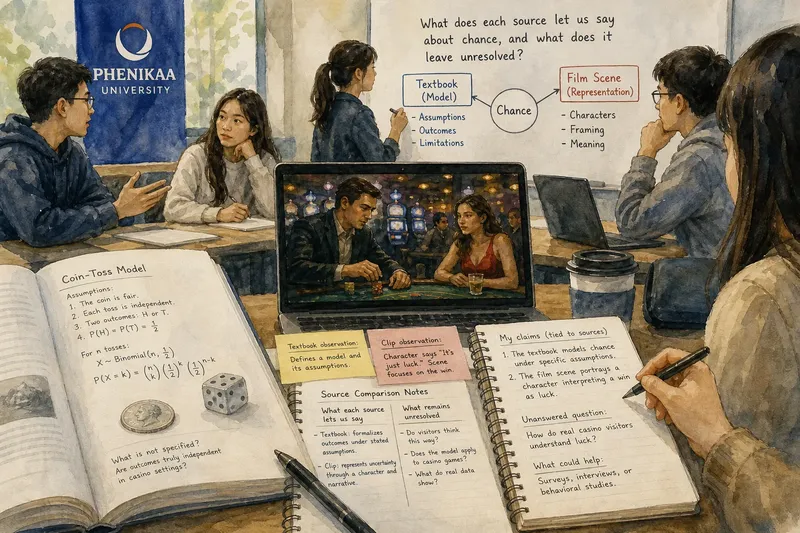
The common mistake in a casino scene is treating “lucky” as a game rule. In a Phenikaa University class discussing casino culture, that shortcut can erase the difference between a character’s belief and the way a story builds meaning around chance.
Students can keep those questions distinct by examining how the scene is made: its point of view, imagery, dialogue, and storytelling choices. That approach makes room for personal and cultural interpretations without mistaking them for descriptions of how a game works.
Read casino scenes
Start with the scene’s form, not with a verdict about whether luck is real. Identify what the audience sees and hears, then ask how the story guides attention. A close-up of a charm, a pause before a reveal, or a character’s repeated ritual may shape suspense or reveal anxiety; those are narrative choices to interpret.
For a class discussion, keep notes in three columns: scene detail, possible meaning, and question for discussion. Record a detail such as “the camera returns to the token,” an interpretation such as “the token may signal hope,” and a question such as “does the character rely on it to manage uncertainty?” This format keeps an interpretation tied to something observable while leaving room for disagreement.
Track symbols and story
- Point of view: Check whose experience shapes the scene. If viewers know only what a player believes, discuss that limited perspective; if the scene offers additional viewpoints, compare what each one makes visible.
- Repeated imagery: Check whether an object, color, or gesture returns. If it recurs near moments of tension, consider how repetition builds emphasis; if it appears only once, avoid claiming that it establishes a continuing motif.
- Editing and pacing: Check whether the scene lingers, cuts away, or delays a reveal. If the timing stretches uncertainty, describe its suspenseful effect; if the sequence moves quickly, consider how that pace shapes the audience’s attention.
- Dialogue: Check who uses words such as “lucky” and what they are responding to. If a character uses the word, attribute the belief to that character; if another character challenges it, discuss the disagreement rather than treating either line as a rule of the game.
- Game setup: Check whether the story explains the rules or available choices. If it does, describe those details as the scene presents them; if it does not, say the setup is unclear instead of supplying rules from assumption.
- Cultural context: Check whether the scene connects a symbol to a stated tradition, community, or personal history. If it does, discuss that specific connection; if it does not, avoid assigning a cultural meaning without support from the material.
How should scenes be discussed?
What does “lucky” tell the audience?
It may reveal a character’s hope, relief, fear, or way of making sense of uncertainty. Describe who uses the word and what is happening around it before interpreting its role in the story.
Can a symbol shape a scene without changing the game?
Yes. A token or ritual can influence characterization, mood, or audience expectations in the story. Discuss those narrative effects separately from the rules the scene actually provides.
What if the scene leaves the rules unclear?
Say which details are missing, such as how a turn works or what choices the player has. Analyze the storytelling that is visible without filling those gaps with assumed game mechanics.
How can students handle competing interpretations?
Ask each reader to point to a scene detail that supports their reading. If interpretations differ, compare what each explains and note what remains open rather than forcing a single answer.
Follow a scene’s construction
Say a Phenikaa University seminar discusses an invented casino scene: a player keeps a blue token beside the table, the camera returns to it before a reveal, and the player says, “It’s my lucky token.” The class first records what is visible: the repeated shot, the delayed reveal, and the line of dialogue. Students then suggest that the token may represent hope or give the character a familiar focus; those are interpretations of the story’s presentation, not claims about the game’s operation. Because the scene does not explain the rules or connect the token to them, the group describes the outcome as a story event and leaves the mechanics unspecified.
If a student instead reads the token as a sign of anxiety, the class can compare that interpretation with the repeated close-ups and the player’s words. The discussion becomes more precise by asking which details each reading explains, rather than deciding that the symbol has one fixed meaning.
Choose precise wording
For written analysis, make the sentence match the kind of claim you intend. “The player calls the token lucky” reports dialogue. “The repeated close-up makes the token prominent” describes the scene’s form. “The token may represent hope” offers an interpretation that readers can weigh against other details.
When discussing casino culture at Phenikaa University, treat luck as a word a story can use to shape character, mood, and audience expectation. A close reading of how the scene presents chance lets students discuss those meanings without claiming that a symbol explains how an outcome occurred.