Planning a Campus Conversation Around One Casino Image
Use one casino image to help Phenikaa students separate visual storytelling about chance from claims that require mathematical or historical sources.
The most common mistake in a campus conversation about casino culture is treating a dramatic image as evidence about how games work. That shortcut costs students a useful distinction: an image can shape an idea about chance, but it cannot establish rules, odds, or anyone’s actual experience. At Phenikaa University, use the image to examine how chance is framed, then identify which questions need another kind of source.
Set the source boundary
Choose an image students can discuss and identify: a film still, a casino advertisement, or an illustration. Record its creator or title when known, its format, and where it appeared. Keep those details separate from interpretation. “The advertisement shows a roulette table” is a source description; “the advertisement makes roulette look glamorous” is an interpretation to examine.
Before displaying it, check the source’s terms and your course or university rules for classroom use. If permission or attribution is unclear, choose a suitable alternative or discuss a text description instead. Do not present a fictional scene, promotional image, and documentary photograph as interchangeable records of real casino life.
Map the image’s claims
Rather than asking only what attracts the eye, ask what kind of claim the image invites viewers to make. A film still may suggest suspense; an advertisement may associate a venue with celebration; an illustration may reduce a complex activity to a single symbol. Those are claims about representation, not direct evidence that viewers, players, or casinos behave that way.
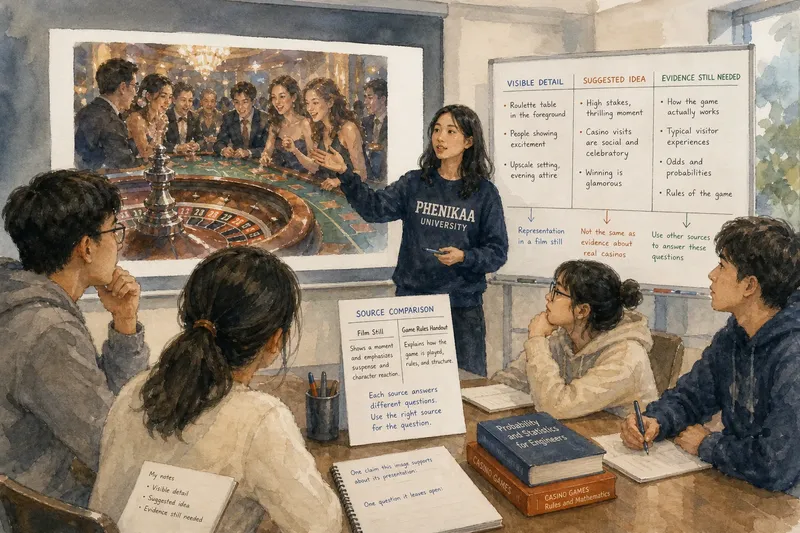
Have students sort their notes into three columns: visible detail, suggested idea, and evidence still needed. For instance, “a celebratory crowd is shown” is a visible detail; “casino visits are always social” is a broader claim that the image alone cannot support. The last column gives students a way to keep curiosity without treating an impression as a conclusion.
Use a source comparison
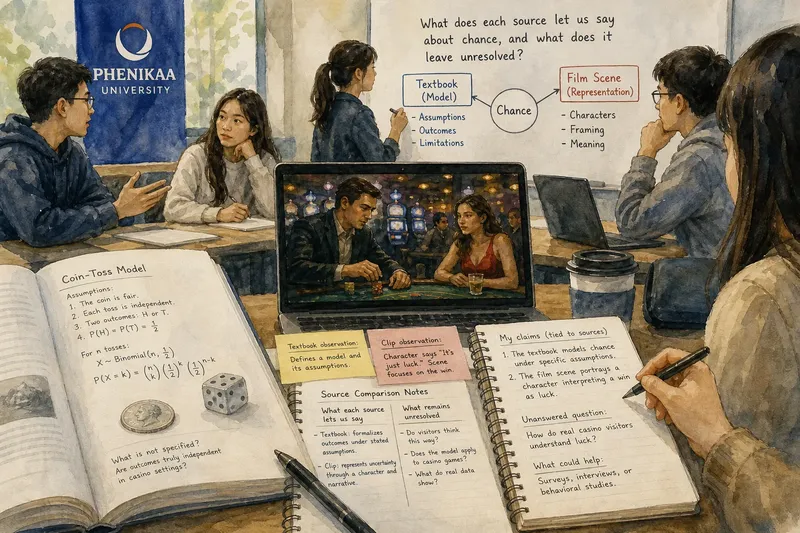
One still can prompt discussion, but comparison makes its limits easier to see. Pair it with a different kind of source on the same subject, such as an official game-rules page for rules or a course text on probability for mathematical concepts. Ask what each source is suited to answer and what remains outside its scope.
Say you bring an invented film still showing a roulette table in a fictional scene and pair it with a game-rules handout supplied for class. Students record that the still emphasizes a character’s reaction, while the handout describes how a game is played. They decide the still can support a discussion of the film’s portrayal of suspense, but the handout—not the image—is the relevant source for rules. Neither item alone establishes what a real visitor felt or what happens at a particular venue.
Guide the conversation
Put a projector or shared screen, a whiteboard or shared document, and a short set of prompts to work. Give students time to write before discussion so that quick speakers do not set the only terms of interpretation.
- Check whether the image’s source and intended context are identifiable; if they are, describe them neutrally, and if they are not, replace the image or state the uncertainty.
- Check whether a comment names a detail actually visible in the image; if it does, record the detail, and if it does not, ask for a source or mark it as an open question.
- Check whether an interpretation is being presented as a fact about casino culture; if so, label it as a reading and seek a relevant source, and if not, continue examining the representation.
- Check whether the discussion makes a claim about rules or probability; if it does, consult an appropriate instructional source, and if it does not, keep the focus on the image’s message.
- Check whether the source is fictional, promotional, or documentary; if its format is known, explain how that affects the claim it can support, and if it is unknown, avoid treating it as a record of actual events.
- Check whether students have had a quiet way to contribute; if they have not, pause for written notes or a shared document, and if they have, invite contributions from both written and spoken discussion.
Questions about casino images?
Can an image explain how a casino game works?
No. An image may depict a game, but rules and probability need a suitable instructional or mathematical source.
How should students handle disagreement?
Ask each student to connect a reading to a visible detail, then keep distinct interpretations on the board. If the image cannot settle the disagreement, leave it unresolved rather than choosing one as fact.
What should a source note include?
Include the creator or title when known, the image format, and its source. Keep evaluative language out of the note so students can make and discuss their own readings.
How does this fit Phenikaa’s academic life?
It supports familiar academic habits: identify a source, define what it can answer, and seek another source when a question exceeds its scope. Keep the comparison focused on learning practices, not on treating casino culture and university life as equivalent.
End with a research question
Invite each student to name one claim the image supports about its own presentation and one question it leaves open. A useful casino image discussion at Phenikaa University does not need to settle what casino culture is; it should help students distinguish a portrayal from evidence and choose a more suitable source for the next question.